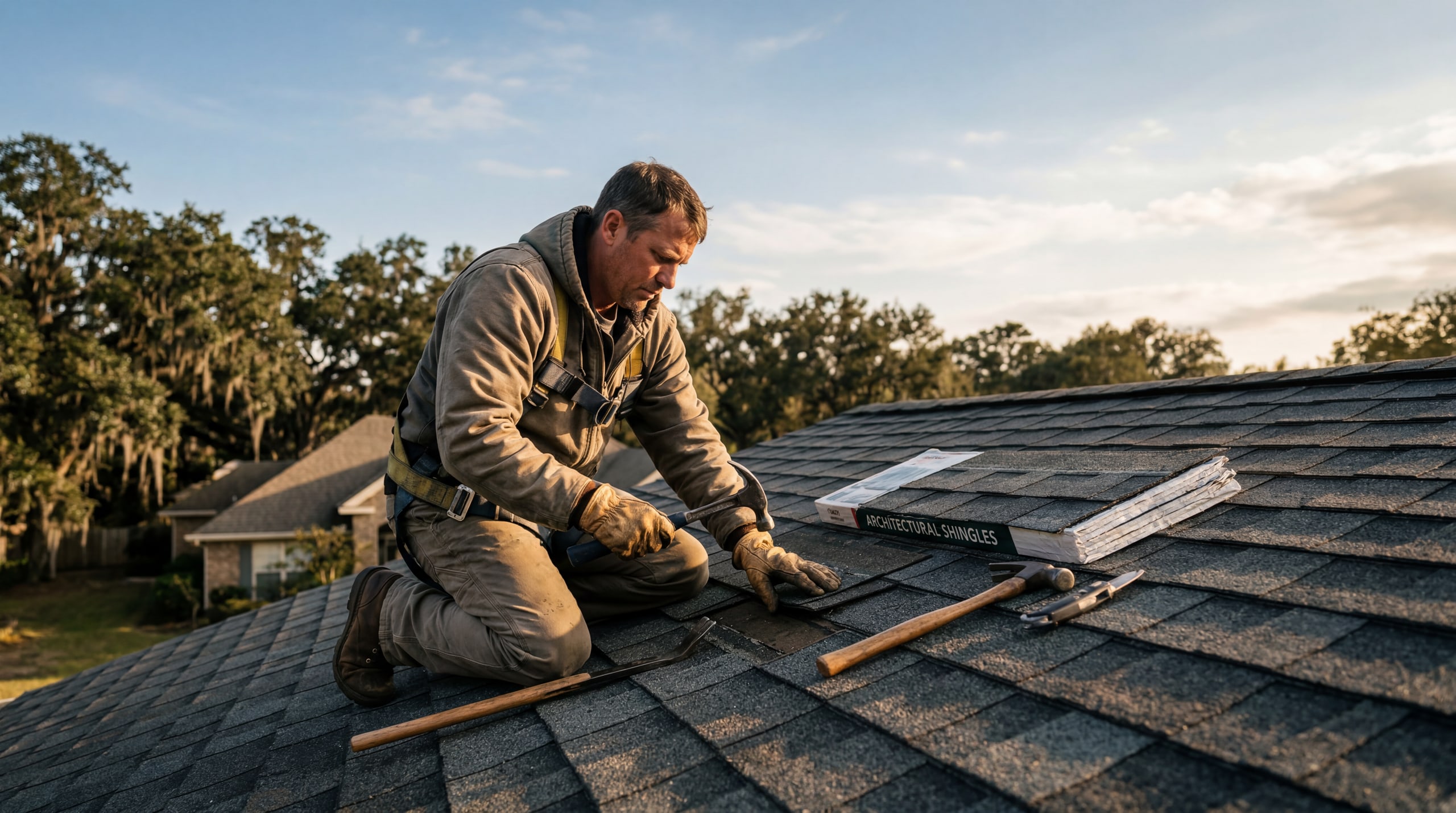
Roof Repair
Fix the leak. Save the roof.
Most leaks are small problems caught early. We find the source, match the material, and seal it for the long haul.
- Same-week scheduling
- Owner on site
- Matched materials
- Honest repair-vs-replace advice
What homeowners feel
What's usually going on when folks call.
A repair is rarely just about shingles. It's a ceiling stain showing up after a Gulf Coast thunderstorm, a roofer who never came back, or a stretch of wind that lifted half the ridge cap. Here are the four scenarios we see most often.
Active leak after a storm
Wind lifted a few shingles or stripped a vent boot, and now there is a stain on the ceiling. You need it stopped before the next rain.
Missing or curling shingles
Granules in the gutter. Tabs flapping after the last wind event. The roof is fixable, but the clock is ticking on the deck below.
Flashing failures at penetrations
Chimneys, skylights, plumbing vents, and dormers are where most Gulf Coast leaks start — long before the shingles fail.
Valley and ridge wear
Water runs hardest down valleys. When the seal at a valley or ridge cap breaks, you get drips far from the actual source.
What Optimum does
Find the source. Fix it once. Tell you the truth about the rest.
A good repair starts with finding where the water is actually getting in — which is rarely where the stain shows up. We climb the roof, we check the attic, and we pull back enough material to confirm the source. Then we fix it with matched material and document the work with photos so you have proof for the next owner, or your insurance carrier if it comes to that.
Find the source
Roof walk + attic check + moisture inspection. We show you the photos before we quote.
Fix it once
Matched shingles, fresh ice-and-water shield, and proper flashing. No patchwork over patchwork.
Tell you the truth
If a repair won't buy you enough years to make sense, we say so. Honest repair-vs-replace, in plain English.
Repair or replace?
A simple decision tree.
We do not push replacements. Most repairs we quote stay repairs. Use this as a starting point — we'll confirm in person.
Likely a repair
- Roof under 12 years old
- Damage confined to one slope or area
- Deck still sound under the failure
- Matching shingles still available
Could go either way
- Roof 12–18 years old
- Multiple small leaks across the roof
- Wind damage with possible insurance claim
- Granule loss visible from the ground
Likely a replacement
- Roof past 18–20 years
- Deck soft or rotten in multiple spots
- Repairs already done two or three times
- Selling the home soon
How it goes
From your call to a fixed roof.
Step 1
Free roof check
Same-week inspection in most of Baldwin County. We climb the roof, photograph what we see, and write it up.
Step 2
Straight diagnosis
We show you the source — not just where it dripped — with photos you can see.
Step 3
Targeted repair
Matched shingles, new flashing or boot, sealed and tied into the existing system.
Step 4
Walk-through and warranty
We show you the finished repair and stand behind it in writing.
Materials we install
Matched to your roof, not the truck.
Architectural asphalt shingles
Color-matched to your existing roof where the manufacturer still produces the color.
Lead and aluminum pipe boots
Coastal-grade replacements for cracked or sun-baked boot flashings.
Galvanized step and counter-flashing
Sized and cut on site to tie new repairs into chimneys, walls, and sidewalls.
Roofing sealants
Polyurethane and butyl sealants rated for Gulf Coast sun and humidity.
Warranty
Our repair warranty.
Every repair we make carries a 1-year warranty on the workmanship. Where new shingles are installed, the manufacturer's shingle warranty continues to apply per manufacturer terms on any new shingles installed terms.
We document every repair with photos before, during, and after — so if something ever needs revisiting, we both know exactly what we did.
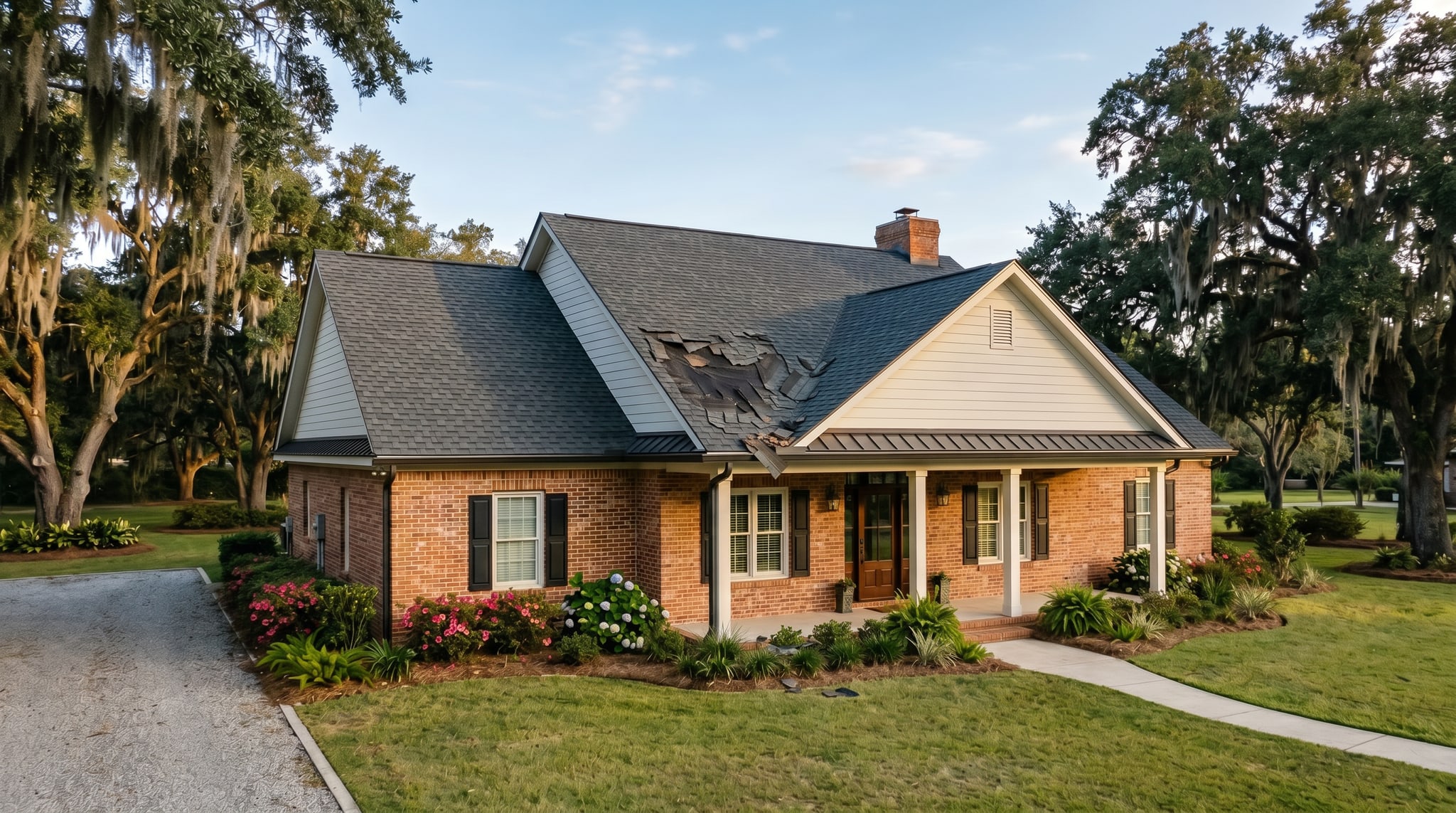
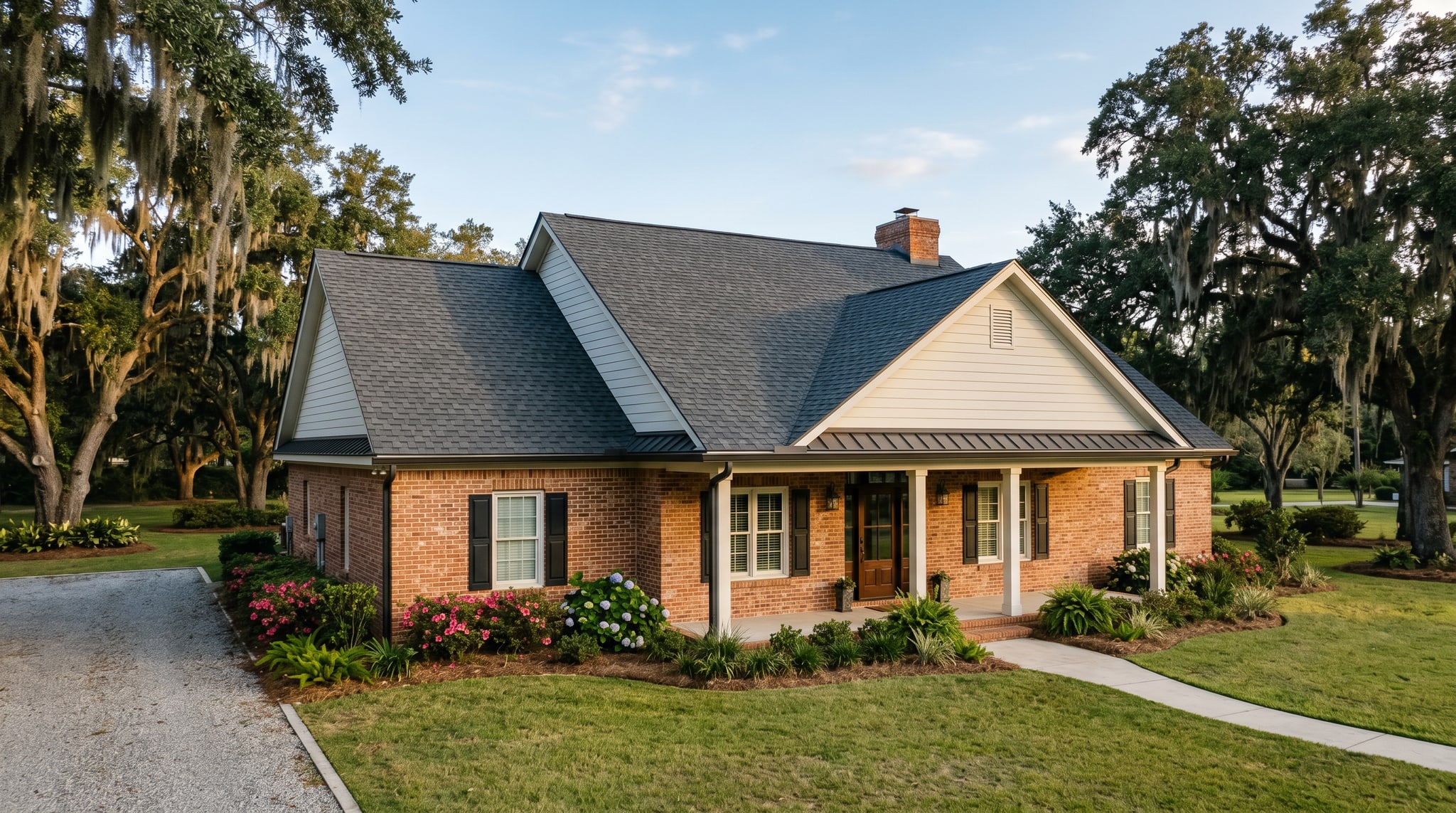
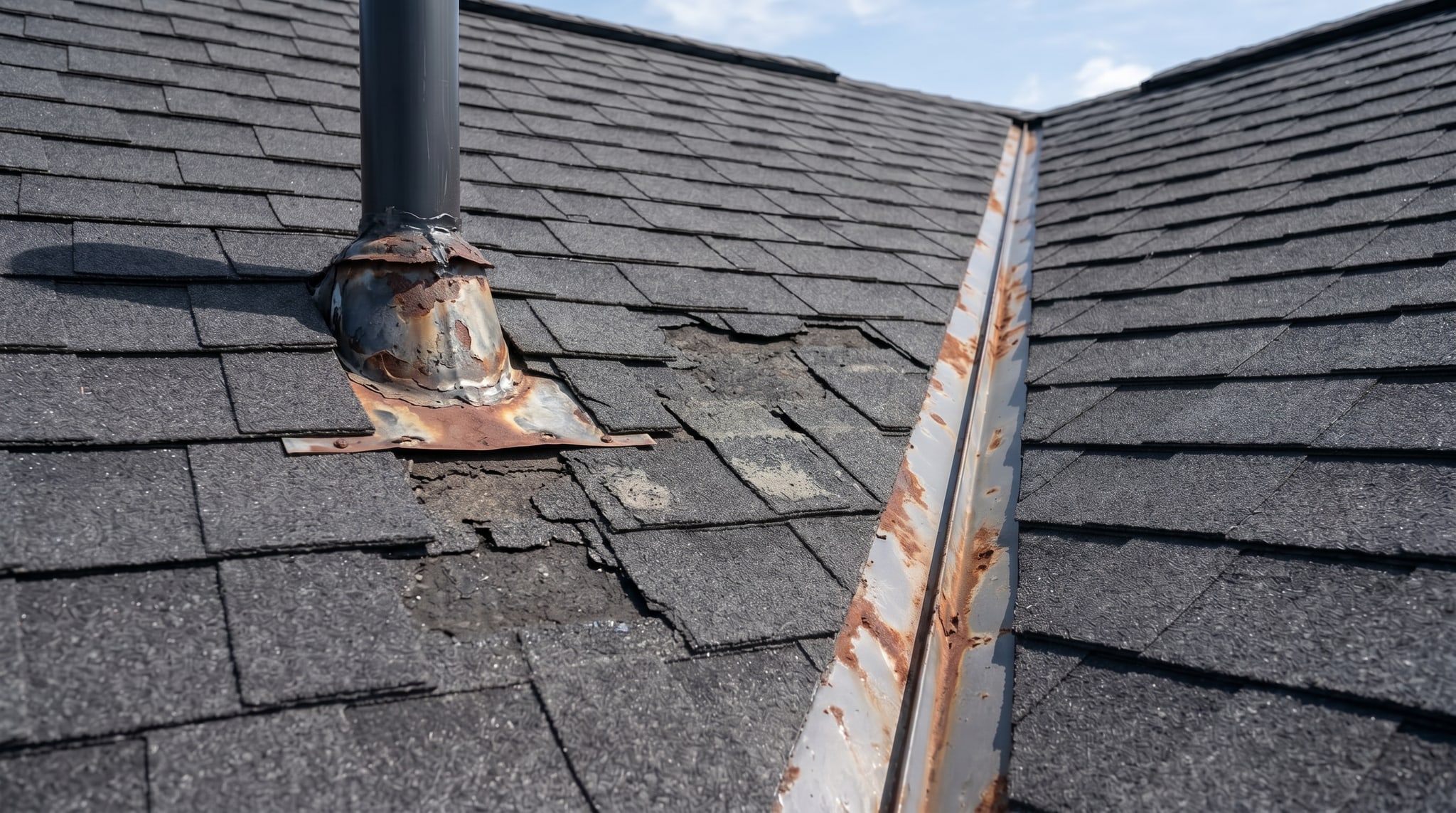
Photo proof
Real repairs, real Baldwin County homes.
Common scenarios
Six Gulf Coast repair scenarios we see most.
Most repair calls are one of six things. Here's what each one looks like, what's actually wrong underneath, and how we fix it.
1. Pipe boot crack
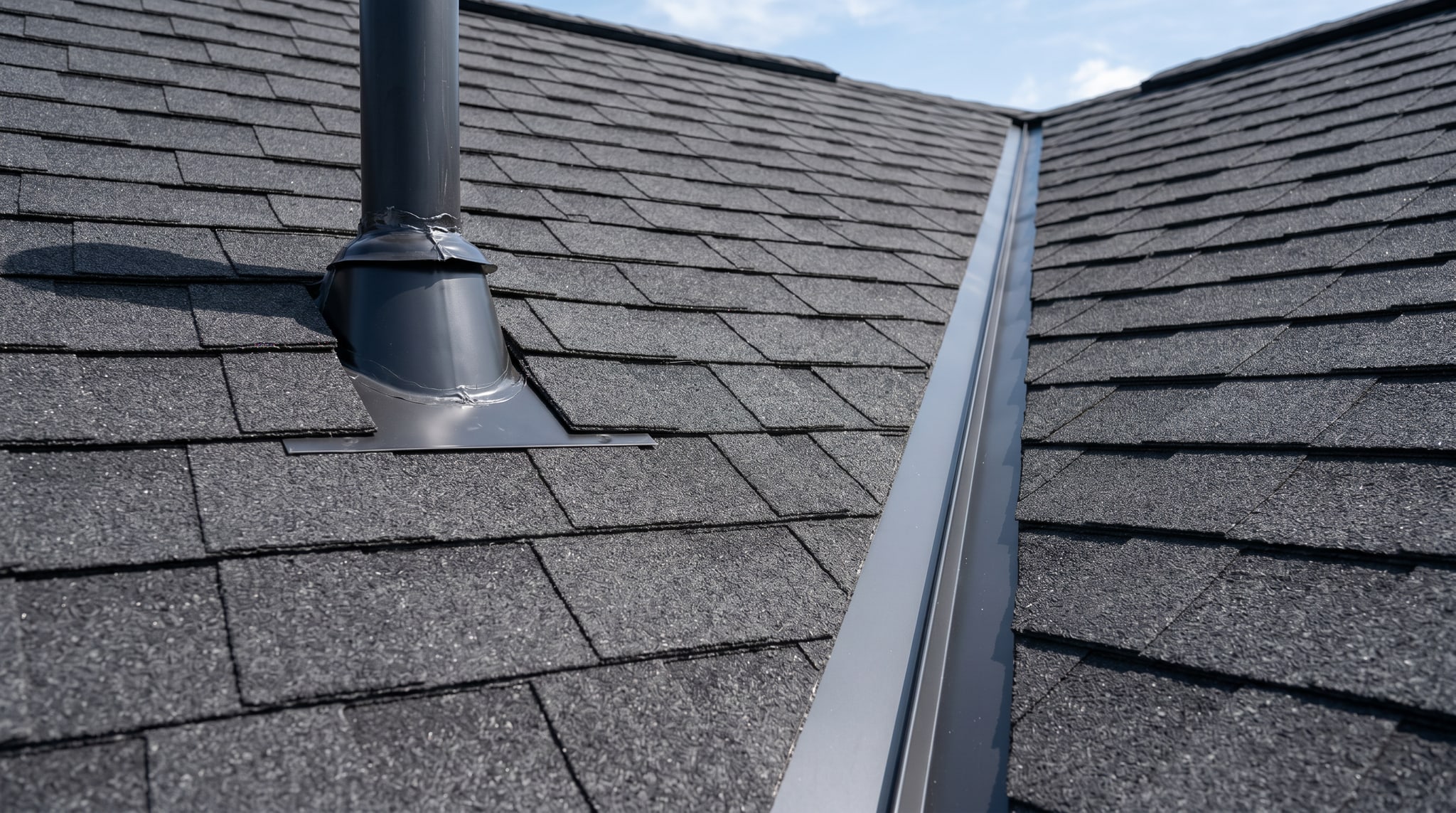
Every plumbing vent on the roof has a rubber-gasketed pipe boot that seals against water. In Gulf Coast UV, the rubber dries out somewhere between year eight and year twelve, cracks, and pulls away from the pipe. Water runs straight down the pipe into the attic. Stains show up in ceilings above bathrooms or kitchens.
The fix is straightforward: pull the cracked boot, install a new one (lead and EPDM combination, or all-metal on coastal homes), and re-seat it into the shingle field. About an hour of work per boot. We replace every boot on every reroof — the old ones aren't worth saving.
2. Valley wear
Valleys carry the highest water volume on the roof — water from both slopes funnels through them to the gutter. Two failure modes: debris dams up the valley and water backs up under the shingle, or the valley material wears thin from constant scouring. Either way, leaks show up along interior walls running parallel to the valley.
Repair scope: clear the valley, inspect the underlying metal or woven shingle, replace any worn pieces, and add ice-and-water shield underneath if the original install skipped it. For severely worn valleys we replace the full assembly.
3. Flashing failure — chimney or skylight
Where the roof meets a vertical surface, flashing ties the two together. Step flashing along the sides, headwall flashing across the top, counter flashing folded into a brick joint on chimneys. Failures here are the most common older-roof leak we see. Stains show up near or below the chimney, sometimes traveling along framing several feet from the actual entry point.
Fix: replace step flashing, cut new counter flashing into a fresh brick joint, refresh sealant, add a cricket behind wider chimneys if there isn't one. On skylights, we replace the manufacturer flashing kit and reseat the curb.
4. Wind damage — missing shingles and lifted tabs
Gulf Coast wind events lift shingles, pop nails through the shingle face, and tear tabs along the edges. None of this shows up as a dramatic hole — it shows up as small breaches that take their own time to leak. After any wind event over 40 mph, walk the perimeter and look up: missing tabs, lifted corners, exposed nails, granules in the yard or gutters.
Repair scope: re-set or replace popped nails, replace missing shingles with matched material, reseal lifted tabs, and inspect surrounding fasteners. Wind events tend to damage adjacent shingles even when only one is visibly off.
5. Ridge cap lift
The ridge cap — specialty shingles bent over the peak of the roof — takes wind on both sides. Once the adhesive seal breaks, the cap lifts in the next gust and exposes the ridge vent or the underlying shingle to direct water. Stains show up in upper-story ceilings, often along the centerline of the house.
Repair scope: pull the failed ridge cap, replace with new cap shingles, refresh the seal between courses, and inspect the ridge vent underneath. If the vent itself is damaged, we replace it.
6. Nail pops
A nail pop is exactly what it sounds like — a roof nail that has worked its way up through the shingle face over time, typically from deck movement, temperature cycling, or a shingle that wasn't properly nailed at install. The raised nail head sometimes punches a small hole in the shingle above it, or it lifts the shingle off the deck. Either way, water finds a path.
Repair scope: pull the popped nail, drive a new ring-shank nail nearby, patch the hole with sealant or a small piece of ice-and-water, and reseat the shingle. We inspect surrounding fasteners — if one nail popped, the pattern suggests others might be close.
Common questions
Questions about roof repair
- Most repair inspections in Baldwin County happen within the week. Active leaks get bumped to the top of the schedule.
- Not when done correctly. We install with the same fastening and flashing details the original manufacturer requires.
- Yes, on most roofs under 18–20 years old. We will tell you honestly when a repair is the wrong call.
- We match as close as the manufacturer still produces. Older roofs may show a slight color shift that fades together within a season.
- We replace the bad decking before we lay the new material. You will see the rotted board and the new board in the photo write-up.
- Yes. You get a written labor warranty on every repair.
Related services
If a repair isn't the right fit.
Emergency Leak Repair
Fast tarping and leak stabilization for active leaks across Baldwin and Mobile counties.
Learn moreRoof Replacement
Full tear-off and re-roof with Gulf Coast wind-rated systems and clean job-site practice.
Learn moreStorm Damage
Gulf Coast wind and hail damage response — tarping, documentation, and full restoration.
Learn moreWhere we work
Serving the Alabama Gulf Coast.
Stapleton, Bay Minette, Loxley, Robertsdale, Foley, Daphne, Spanish Fort, Fairhope, Gulf Shores, Orange Beach, Mobile
Same-week repair
Got a leak or a missing shingle?
Send us a photo or your address. Jon Jon or Justin will call you back within 1 business hour and tell you whether you need a repair, a replacement, or just a peace-of-mind look.