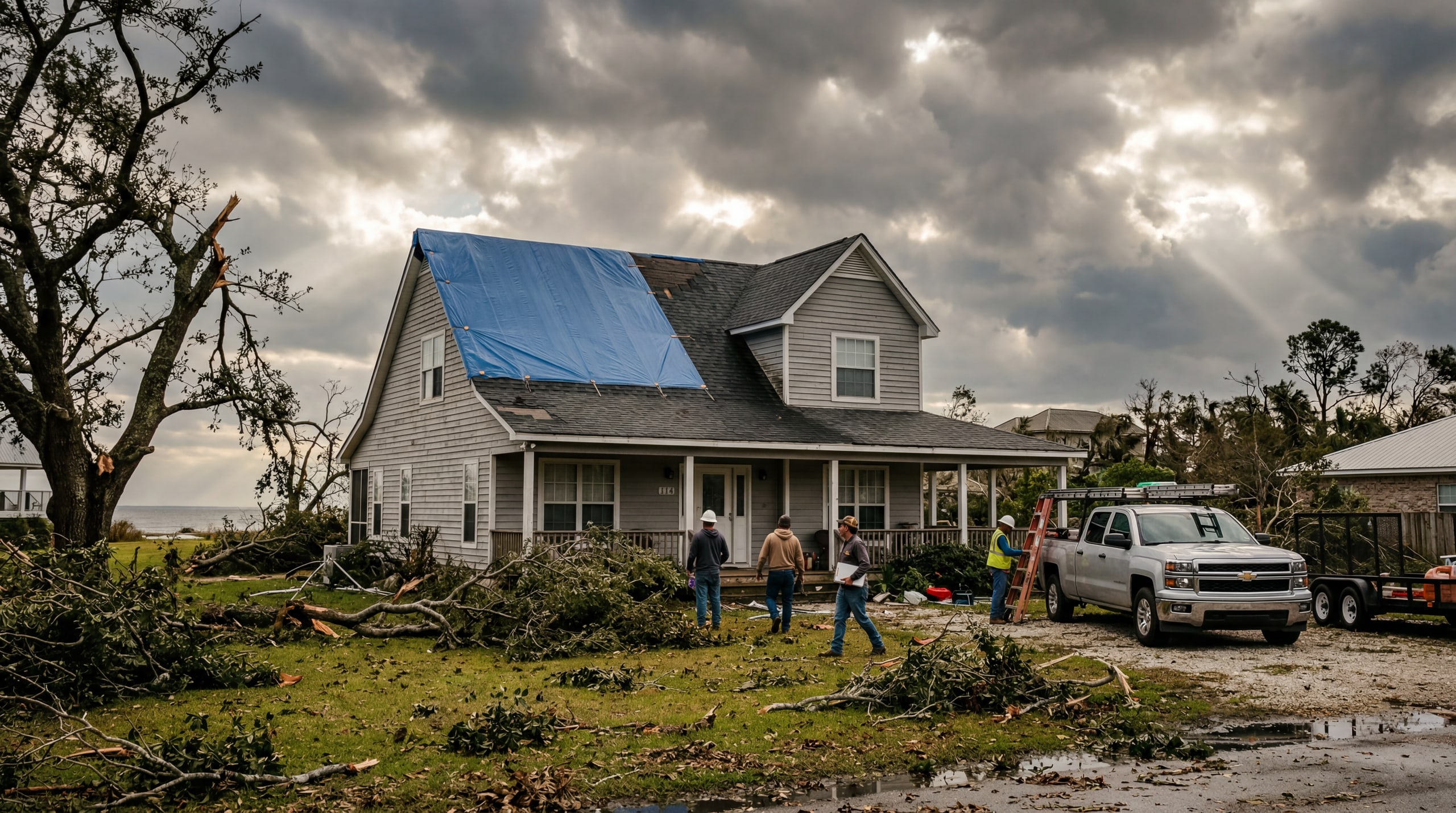
Storm Damage Response
Storm hit? Start here.
We tarp the active leak, document the damage with photos and drone, and walk your claim from first call to final shingle.
- Same-day tarping
- Drone documentation
- We meet your adjuster
- Xactimate-ready scope
Important: Insurance language disclaimer. We help document and explain — final claim outcomes are determined by your carrier.
What homeowners feel
Four scenarios we see after every storm.
Wind stripped shingles off a slope
Tabs missing across a field or an entire slope after the last system. Underlayment is now the only thing between weather and the deck.
Tree or limb through the roof
Active hole, exposed insulation, water in the attic. This is a same-day call.
Hail bruised the shingle
Damage may not show from the ground. The carrier wants documented bruising before they will write the scope.
Active interior leak after a storm
Ceiling stain growing, drywall sagging — the storm exposed a weak spot in the system.
First 24 hours
What to do right now.
The first day after a storm is when claims get won or lost. Follow this checklist before you do anything else.
- 1
Get everyone safe and dry
If water is coming in, move furniture, set buckets, and shut off power to wet rooms. Safety first, roof second.
- 2
Take photos from the ground
Wide shots of every side of the house. Close-ups of any debris on the ground. Date-stamped if your phone allows.
- 3
Call us for an emergency tarp
(251) 406-3624. Same-day tarp where it's safe to climb. The tarp protects your home and your claim.
- 4
Call your insurance carrier
Open a claim and get a claim number. Don't agree to a number from the carrier until your roof has been independently inspected.
- 5
Save every receipt
Tarps, buckets, hotel nights, food spoilage. Many carriers reimburse under loss-of-use or emergency mitigation.
- 6
Do not throw anything out yet
Save damaged shingles, fallen limbs, and debris until the adjuster sees them or photos confirm the loss.
- 7
Schedule your free claim review
We'll meet you and document the roof with photos and drone imagery before the adjuster shows up.
What Optimum does
Tarp pledge, drone docs, scope that holds up.
Storm work is half craftsmanship and half paperwork. The roof has to be stabilized today. The documentation has to hold up when the adjuster shows up. The scope has to be written in the language your carrier's software speaks. We handle all three.
Wind-rated asphalt and metal systems
Manufacturer lines rated for high-velocity coastal wind zones.
Synthetic underlayment + ice-and-water
Self-adhered ice-and-water at eaves and valleys, synthetic underlayment across the field.
Replacement decking
Plywood or OSB sized to manufacturer spec where the storm damaged the existing deck.
Coastal-grade fasteners
Stainless or hot-dipped galvanized fasteners sized for the panel and the wind zone.
Carriers we've worked with
We speak their format.
State Farm / Allstate / USAA / Farm Bureau / Travelers / Liberty Mutual
We do not represent any carrier. We are your contractor. Our job is to scope the roof correctly and stand behind the work.
How it goes
From the first tarp to the final shingle.
Step 1
Stabilize the home
Tarp the active leak so the inside of the home stops taking water.
Step 2
Document the damage
Ground photos, roof photos, attic photos, drone if needed — built for the carrier.
Step 3
Meet your adjuster
We climb the roof with the adjuster so the scope reflects what we actually found.
Step 4
Scope and approval
We review the scope, supplement when items are missed, and confirm before any work starts.
Step 5
Restoration
Full re-roof or zoned restoration with Gulf Coast wind-rated materials.
Step 6
Final walk and paperwork
We close the claim with the carrier and hand you a clean file.
Warranty
What backs the restoration.
Restored roofs carry the full manufacturer warranty (GAF / OC / CertainTeed) plus our year workmanship warranty — the same as a replacement we'd quote outside of a claim.
Photo proof
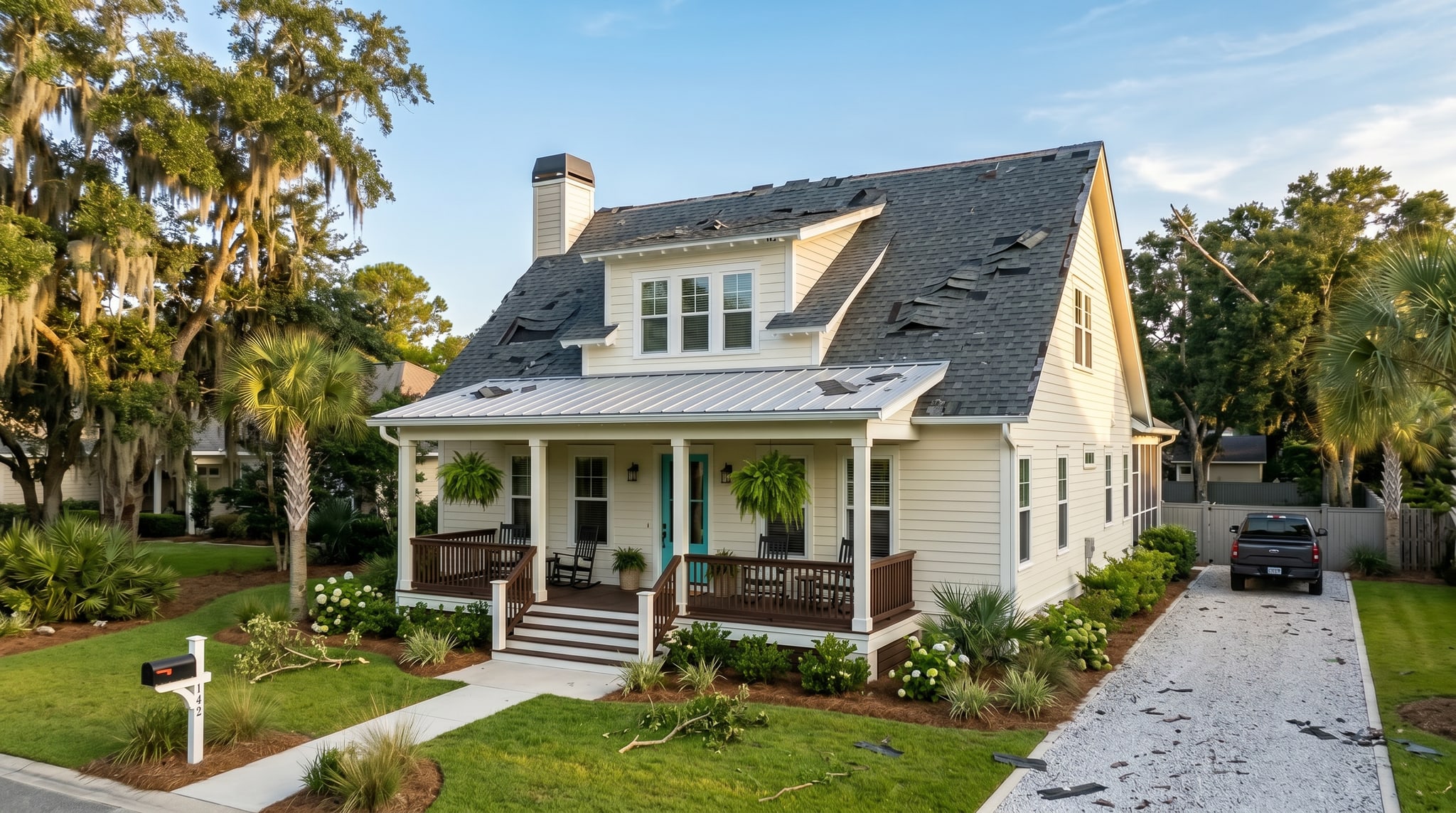
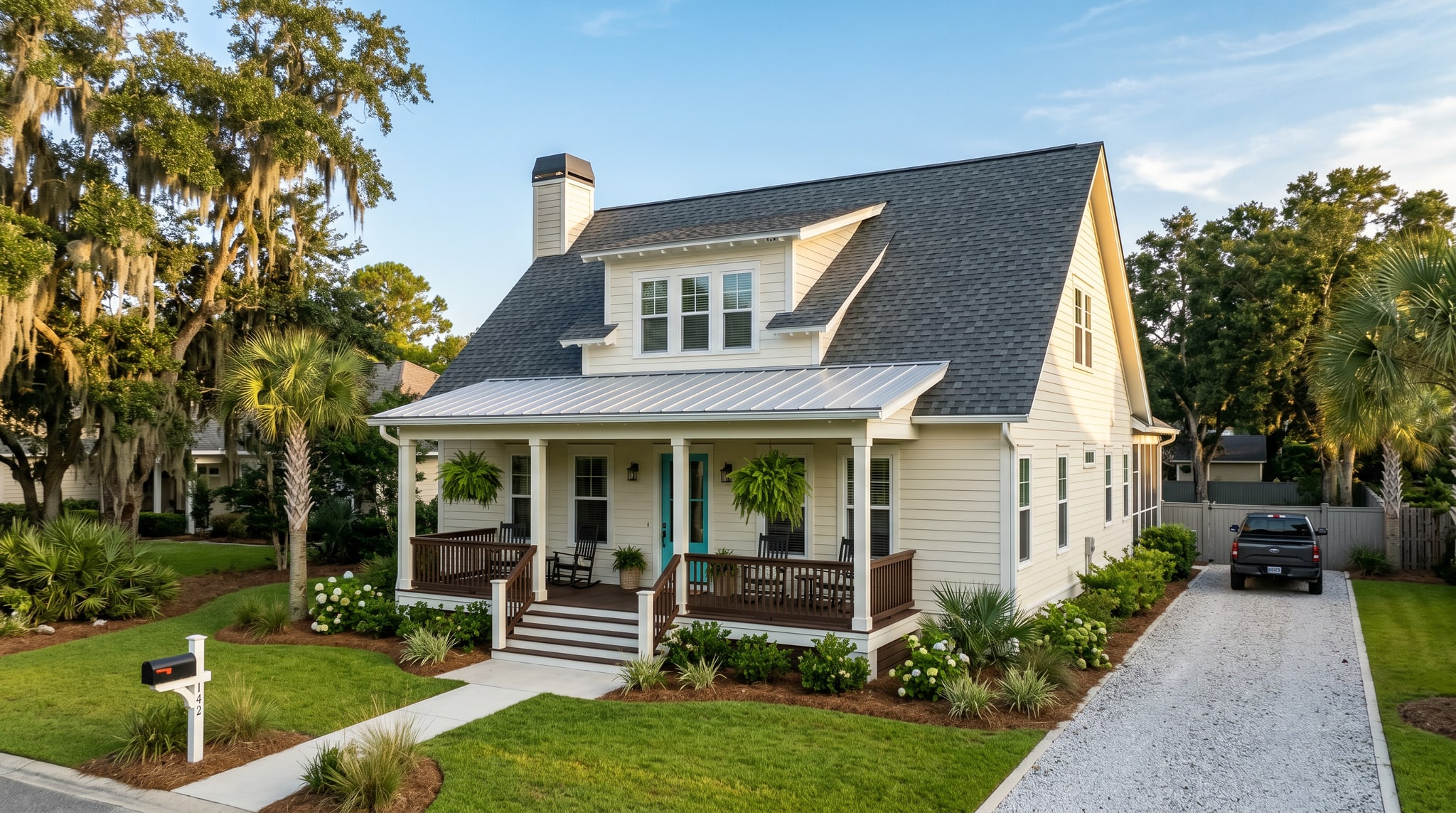
Storm restorations on the Gulf Coast.
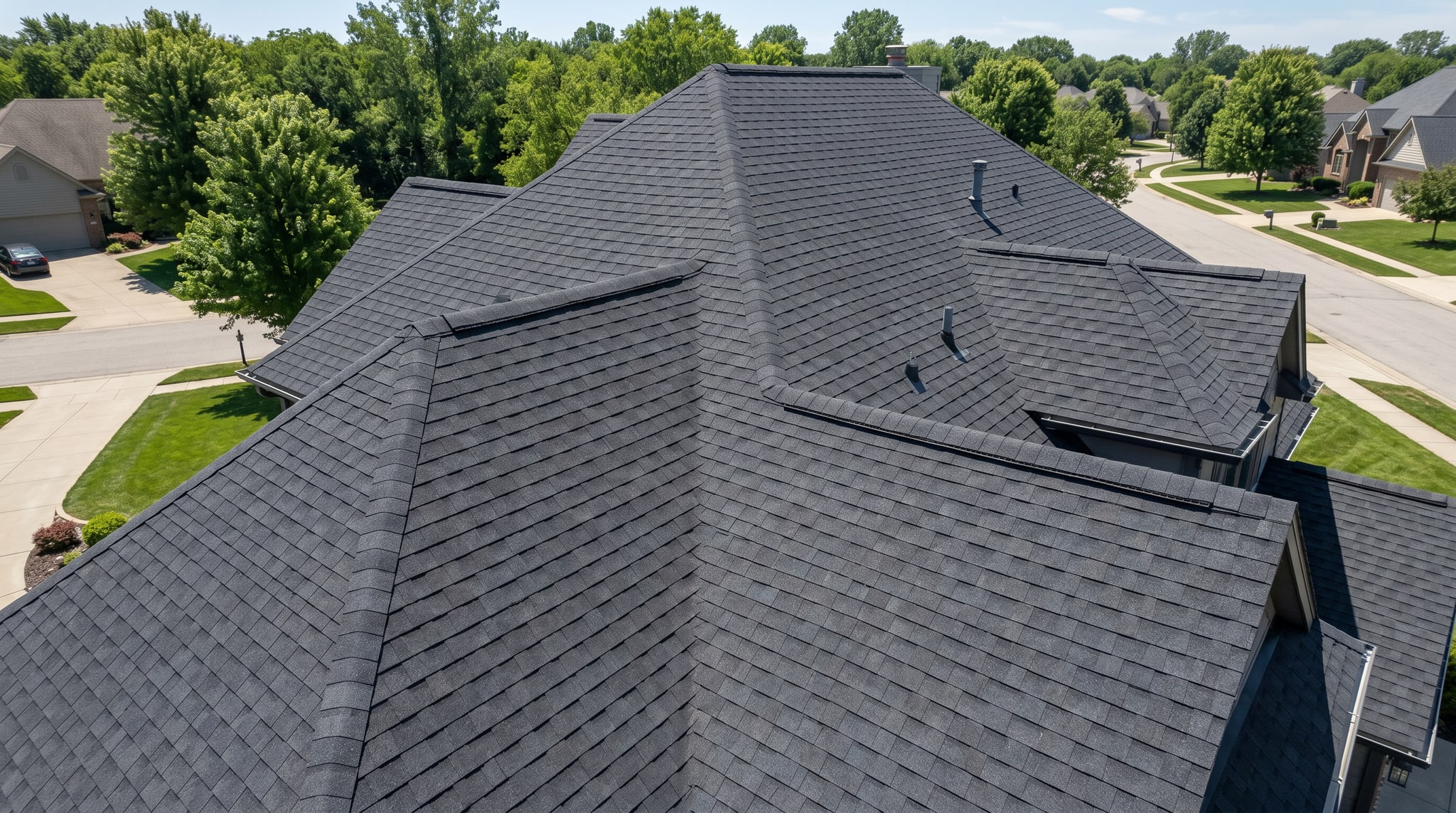
Damage types
What storm damage actually looks like.
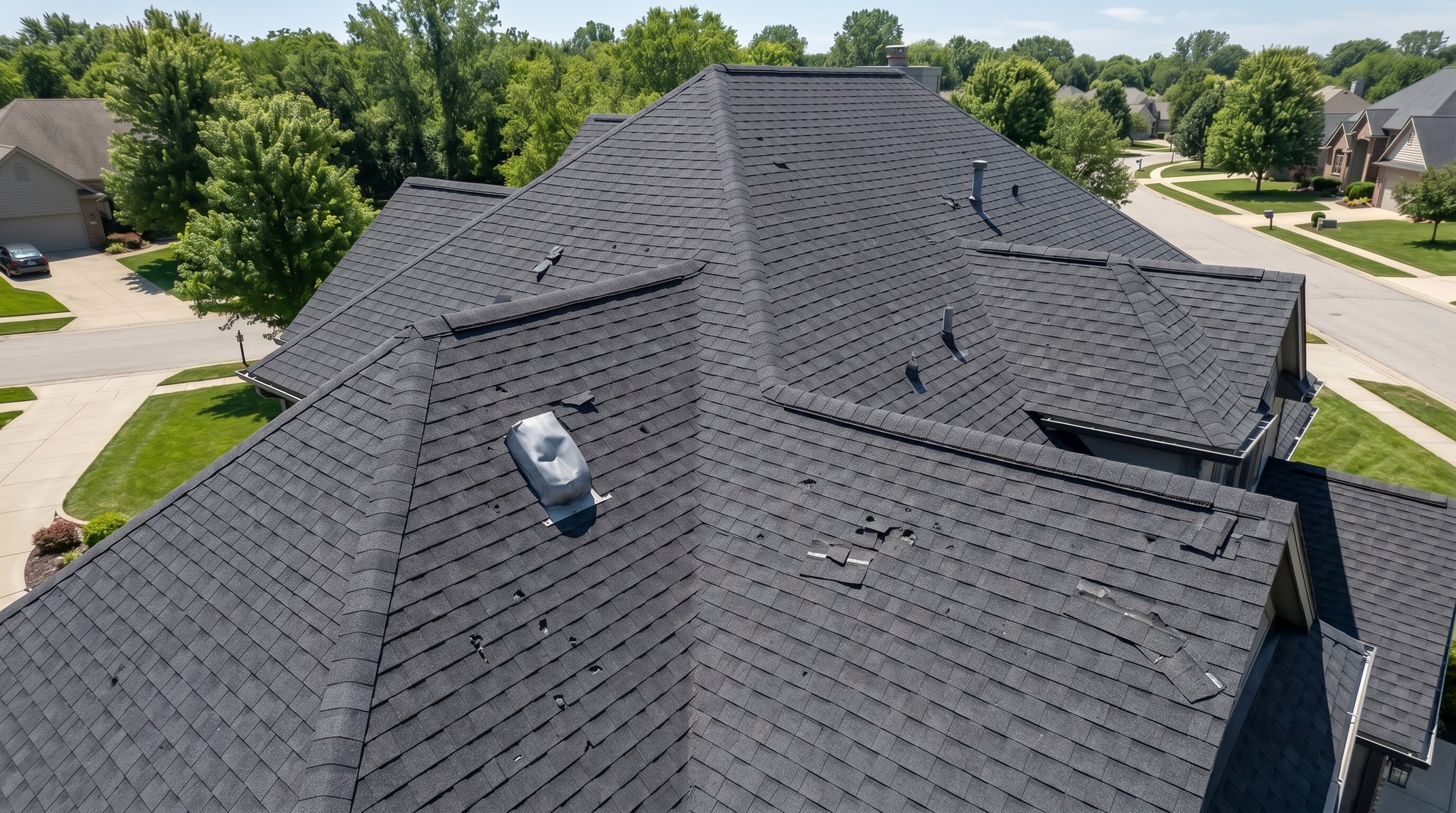
Adjusters look for specific damage signatures on a roof. So do we. Here are the six patterns that show up after every Gulf Coast storm — and what each one means for your scope.
1. Lifted or missing shingles
The most common wind-damage signature. Shingle tabs lifted up and bent backward by uplift force, sometimes still attached, sometimes torn off completely. Adjusters look for the “25 percent rule” — when more than a quarter of a slope shows uplift damage, the full slope is generally owed under replacement . Lifted tabs may seal back down in heat but the underlying adhesive bond is broken — the next wind event takes them off.
2. Granule loss
Hail and wind-driven debris strip the protective granules off the shingle surface. Look for dark patches where the asphalt is exposed, granules piled in gutters and at downspout outlets, and dimpling on the gutters or AC condenser fins (which document the storm event regardless of roof angle). Granule loss accelerates aging on the affected shingles even if no immediate leak shows up.
3. Hail bruising
Hail impacts compress the shingle without removing the granule layer entirely. The damage shows up as a soft, circular bruise — the mat fibers below the granule layer are crushed, and the area feels slightly soft under pressure. Hail bruising shortens shingle life and breaches the integrity of the mat, even when the shingle still looks intact from the ground. Adjusters mark hail bruises with chalk during a scope walk.
4. Debris impact
Tree limbs, flying debris, or large hail can punch through the shingle and into the wood deck below. Look for cracked or missing shingles in a pattern that doesn't match uniform wind damage. Punctures into the deck need decking replacement underneath, not just shingle replacement. Save the debris until the adjuster has photographed it.
5. Water intrusion
Once the shingle barrier is breached, water tracks through the underlayment, into the deck, and eventually into the attic and ceilings below. Interior signs: brown stains on ceilings, peeling paint, bowed drywall, musty smells from the attic, wet insulation. Document interior damage with photos and don't dispose of saturated insulation until the adjuster sees it. Interior damage is often covered under a separate line of the policy.
6. Soffit, fascia, and accessory damage
Wind doesn't stop at the shingle. Bent or detached gutters, torn soffit panels, lifted ridge cap, damaged ridge vent, broken skylight bubbles, and torn metal valley flashing are all common after Gulf Coast storms. Adjusters often miss these in the initial scope — we document each one specifically so the supplement gets paid. Roof restoration that ignores the accessories isn't a complete restoration.
Common questions
Questions about storm damage
- We aim for same-day or next-day tarping on active leaks during storm season. Call the main line and tell us a leak is active.
- Most homeowner policies cover sudden wind and hail damage. We do not guarantee the carrier's decision — we just document it honestly.
- Yes. We climb the roof with the adjuster so the scope reflects the actual damage.
- You pay your policy deductible. We do not collect anything before materials and labor are earned.
- We have worked with most of the major Gulf Coast carriers.
- Tarping is immediate. Inspection and adjuster meet within days. Build timeline depends on materials and the carrier — usually a few weeks.
- We supplement. If items are missed — code upgrades, decking, drip edge — we document them and request the supplement.
- We handle the roof. Interior restoration we coordinate with a partner or your insurance preferred vendor.
Free claim review
Start your claim review.
Tell us what happened. Send photos if you have them. Jon Jon or Justin will call you back within 1 business hour with the next step.
Related services
What pairs with storm work.
Insurance Claims
Free claim review and adjuster-meet for storm-damaged roofs on the Gulf Coast.
Learn moreEmergency Leak Repair
Fast tarping and leak stabilization for active leaks across Baldwin and Mobile counties.
Learn moreRoof Replacement
Full tear-off and re-roof with Gulf Coast wind-rated systems and clean job-site practice.
Learn moreWhere we work
Serving the Alabama Gulf Coast.
Stapleton, Bay Minette, Loxley, Robertsdale, Foley, Daphne, Spanish Fort, Fairhope, Gulf Shores, Orange Beach, Mobile