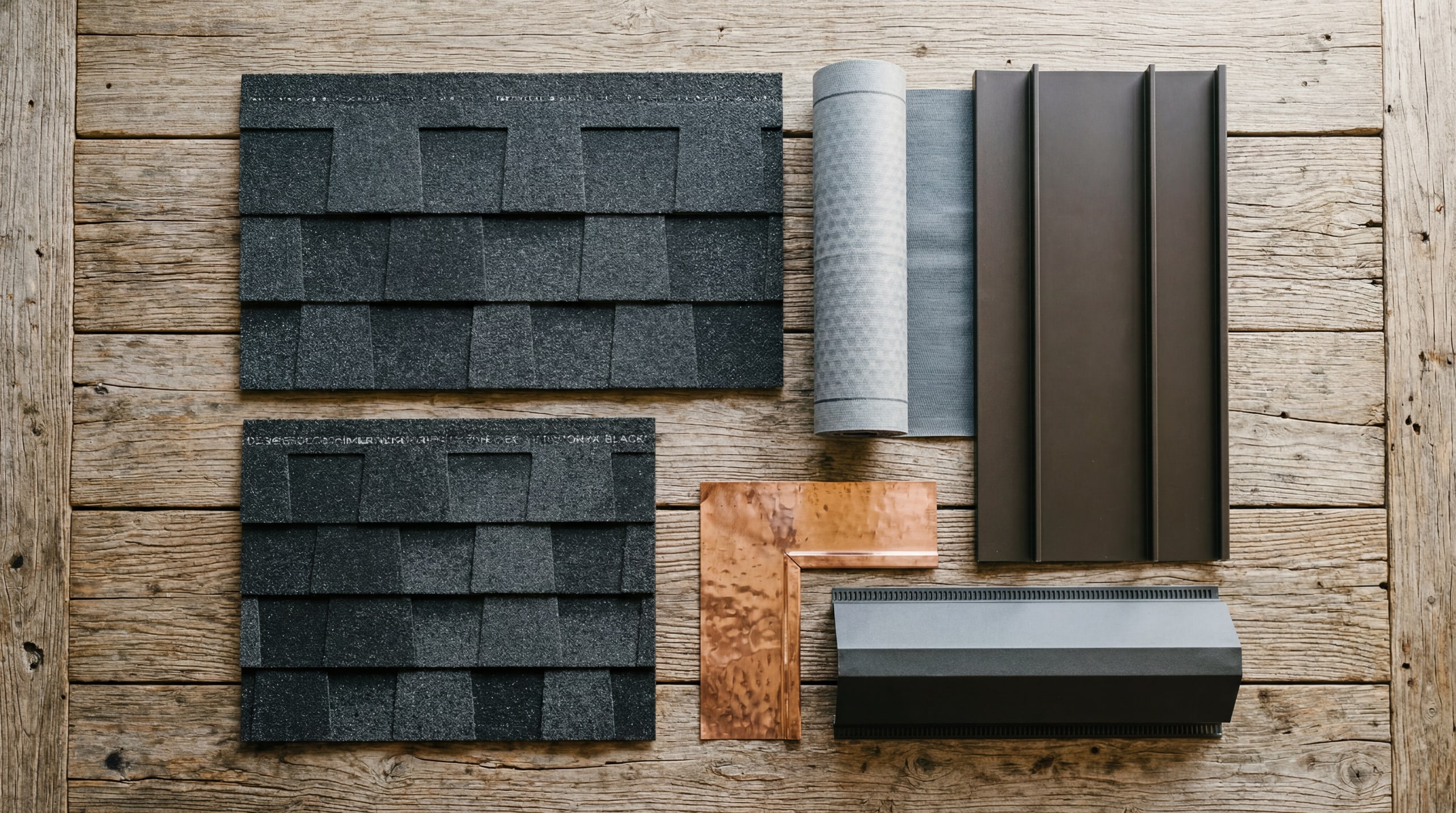
Materials guide
Roof materials for the Alabama Gulf Coast.
Long-form reference on every material we install — shingle, metal, underlayment, flashing, ventilation, and gutters — with the coastal performance notes that matter on Baldwin and Mobile County homes.
- Owner-led installs
- GAF / OC / CertainTeed
- Coastal-grade fasteners
- Manufacturer + labor warranty
Overview
Every part of the system, in plain English.
A roof isn't a shingle. It's a system — deck, underlayment, flashing, fasteners, ventilation, and the shingle or metal panel on top. The system holds water out and lets heat out. Skip any one piece and the roof underperforms. This guide walks through each piece, what we install, and how the Gulf Coast climate changes the right answer.
1. Asphalt shingles
Asphalt is still the most common roof material on the Gulf Coast. Three tiers matter: 3-tab (budget, single-layer), architectural (mid-range, two-layer with shadow lines), and designer (premium, slate or shake-look laminates).
Brand-name lines we install most often: GAF Timberline HDZ, Owens Corning Duration, CertainTeed Landmark for architectural; GAF Glenwood, CertainTeed Grand Manor for designer . Top-tier architectural lines carry 130 mph wind ratings with the high-wind nailing pattern and 30 to 50 year limited warranties.
On the coast we specify the algae-resistant version of every line — copper-granule technology that resists the black streaking common on south- and west-facing slopes in our humidity.
2. Standing-seam metal
Standing-seam is the premium metal roof for coastal homes. Panels run from eave to ridge in continuous lengths. Adjacent panels lock together with a raised seam, mechanically crimped or snap-fit. Fasteners hide inside the seam — no rubber washers exposed to UV, no screw heads to rust.
Gauge: 24-gauge is the coastal standard; 26-gauge is acceptable on lower-pitch outbuildings. Panel width: typically 16 or 18 inches. Substrate: Galvalume (zinc-aluminum-coated steel) for coastal corrosion resistance. Finish: Kynar 500 / PVDF paint system with 30 to 50 year fade and chalk warranty . Clip system: hidden, fastened to the deck, allowing the panel to expand and contract with temperature.
Properly installed standing-seam tests at 140 mph wind uplift or higher — among the most wind-resistant residential roof systems made.
3. Exposed-fastener metal (R-Panel / 5V-crimp)
Exposed-fastener metal is a different category from standing-seam. Screws penetrate the panel face with an EPDM rubber washer for the seal. It's lower cost, faster to install, and well-suited to garages, workshops, barns, and accessory structures.
Gauge: 26-gauge standard, 24-gauge for higher-end installs. Panel width: 36 inches typical. Finish: Kynar 500 or silicone-modified polyester (SMP) .
Service life for exposed-fastener panels is typically 30 to 40 years . The limiting factor is the EPDM washer — the rubber seal under each screw head dries out over time and needs to be addressed at 15 to 20 years. We use it on outbuildings, not primary residence roofs in coastal exposure.
4. Underlayment
Underlayment is the second line of defense against water — the layer between the wood deck and the shingle or metal. Two materials matter on the Gulf Coast.
Synthetic underlayment covers the field of the roof. Woven plastic, grippier and more UV-tolerant than old felt paper, faster to install, more wind-resistant during the install window. We use synthetic on every job.
Ice-and-water shield is a self-adhered rubberized membrane that goes in high-risk zones: eaves (the first 6 feet up from the gutter line), valleys, around every penetration (pipe boots, vents, chimneys, skylights), and against any wall flashing. On the Gulf Coast, where wind drives rain sideways, ice-and-water in valleys is what saves the deck when wind backs water up under the shingles.
5. Drip edge & starter strip
Drip edge is the metal trim that runs around the perimeter of the roof. It directs water off the edge into the gutter and protects the wood fascia from rot. Code (IRC 2018) requires drip edge at eaves and rakes . We hand-bend custom drip edge for unusual conditions and use prefab on straight runs.
Starter strip is the first course of shingles along the eave and rake — a specialty shingle without tabs, designed to seal the first course of full shingles down. Without a starter strip, the roof fails at the perimeter in the first wind event. We always install starter strip; if you see a quote that doesn't include it, ask the contractor why.
6. Ridge vent & attic ventilation
Attic ventilation is what keeps your shingle warranty valid in Gulf Coast heat. Without proper intake at the soffits and exhaust at the ridge, attic temperatures climb above 140°F in July and bake the shingles from below.
We balance the system: continuous soffit intake along the eaves plus continuous ridge vent at the peak, sized to the attic volume per manufacturer spec. Off-ridge box vents are used where the ridge length is too short or the geometry doesn't support continuous venting. Bath and kitchen exhaust vents pipe straight to the outside — never into the attic.
7. Flashing systems
Flashing is the metal that ties the shingles into vertical surfaces — walls, chimneys, skylights, dormers. Most leaks on older roofs come from failed flashing, not failed shingles.
Step flashing runs in pieces along sidewalls, woven into each shingle course. Headwall flashing spans the top of a wall where the roof meets a vertical face. Counter flashing embeds into the brick or mortar joint of a chimney and laps over the step flashing. Kickout flashing sits at the bottom of a sidewall to kick water away from the wall into the gutter — small piece, prevents a lot of damage.
We replace flashing on every reroof. Reused flashing on a new roof is a leak in three to five years.
8. Pipe boots & penetrations
Every plumbing vent on the roof has a pipe boot — a metal flashing base with a gasket that seals around the pipe. Standard rubber EPDM boots last eight to twelve years in Gulf Coast UV before the rubber cracks . Lead and aluminum boots last longer.
Within a mile or two of the water, we spec all-metal boots (lead or coastal-grade aluminum) to avoid the rubber failure mode entirely. Replacement schedule: every reroof, no exceptions.
9. Gutters & downspouts
Gulf Coast rainfall is intense — single-storm totals of 4 to 8 inches happen regularly. Gutters have to be sized for the volume. Standard 5-inch K-style gutters with 2x3 downspouts handle most homes. Larger roofs or roofs that drain a lot of square footage through one corner often need 6-inch gutters or 3x4 downspouts to keep up.
Hidden hangers vs spike-and-ferrule. Hidden hangers (screwed into the fascia) hold up better than the old spike-and-ferrule system, which pulls loose over time. We install hidden hangers on every gutter replacement.
Gutter guards. Worth considering on homes under heavy tree cover. Effectiveness varies widely by product — some are excellent, some make leaf buildup worse. We can walk through specifics when we measure.
10. Solar add-ons & skylights
Solar panels and skylights are roof penetrations, and any penetration is a potential leak point. The key is integration during the install — flashing the unit in to the shingle field, not relying on caulk to seal the edges.
When we install a roof under existing solar, we coordinate with the solar contractor to remove and reset the panels on fresh flashing. When we install a roof with new skylights, we run ice-and-water shield around the curb and use the manufacturer-specified flashing kit. Done right, both can live on a 30-year roof.
Side-by-side comparison
| Factor | Architectural shingle | Standing-seam metal | Designer shingle |
|---|---|---|---|
| Wind rating | 130 mph | 140+ mph | 110–130 mph |
| Warranty | 30–50 yr | 40–50 yr | 50 yr / lifetime |
| Lifespan | 25–30 yr | 40–50 yr | 30–40 yr |
| Cost tier | $$ | $$$$ | $$$ |
| Best for | Most coastal homes | Long hold / beachfront | Historic / luxury |
How we choose for your roof
Every roof check follows the same four-step decision process:
- Hold horizon. How long do you plan to own the home? Under 8 years almost always points to shingle. Over 15 years opens the door to metal.
- Proximity to the water. Within a mile of the Gulf or Mobile Bay, salt-air durability and wind uplift tilt toward standing-seam metal. Inland, both systems perform well.
- Carrier behavior. Check with your insurance agent for a wind-mitigation discount on metal. In some cases the annual premium savings close most of the up-front cost gap .
- Architecture and look. Traditional brick/Hardie homes generally read better with architectural shingle. Modern coastal, agricultural, and steep-pitch homes generally read better with metal.
After those four, the rest comes down to color, manufacturer preference, and budget. We quote both systems on most replacements so you can see the numbers side by side.
Common questions
Materials FAQs
- Architectural asphalt shingles typically last 25–30 years on the Gulf Coast when installed and ventilated correctly. Standing-seam metal commonly delivers 40–50 years. Exact lifespan depends on attic ventilation, fastener grade, and how often the roof sees named-storm wind.
- Not when installed over a solid wood deck and synthetic underlayment, which is how every residential metal roof we install goes on. Inside a well-insulated home, rain on metal is comparable to rain on shingle. The metal-noise myth comes from agricultural barns with no decking underneath.
- Often, yes — if your hold horizon is 15+ years, your home is within a mile or two of the water, or your carrier offers a wind-mitigation discount for standing-seam metal. Metal costs roughly 2 to 2.5 times shingle up front, but delivers nearly double the service life.
- Top-line architectural shingles carry 30–50 year limited warranties from the manufacturer. Standing-seam metal commonly carries 30–50 year paint and finish warranties plus 40+ year substrate warranties. Both are backed by our labor warranty on the install.
Free roof check
Ready to spec your roof?
We'll measure the roof, walk through every material decision on this page in person, and quote what fits your home.